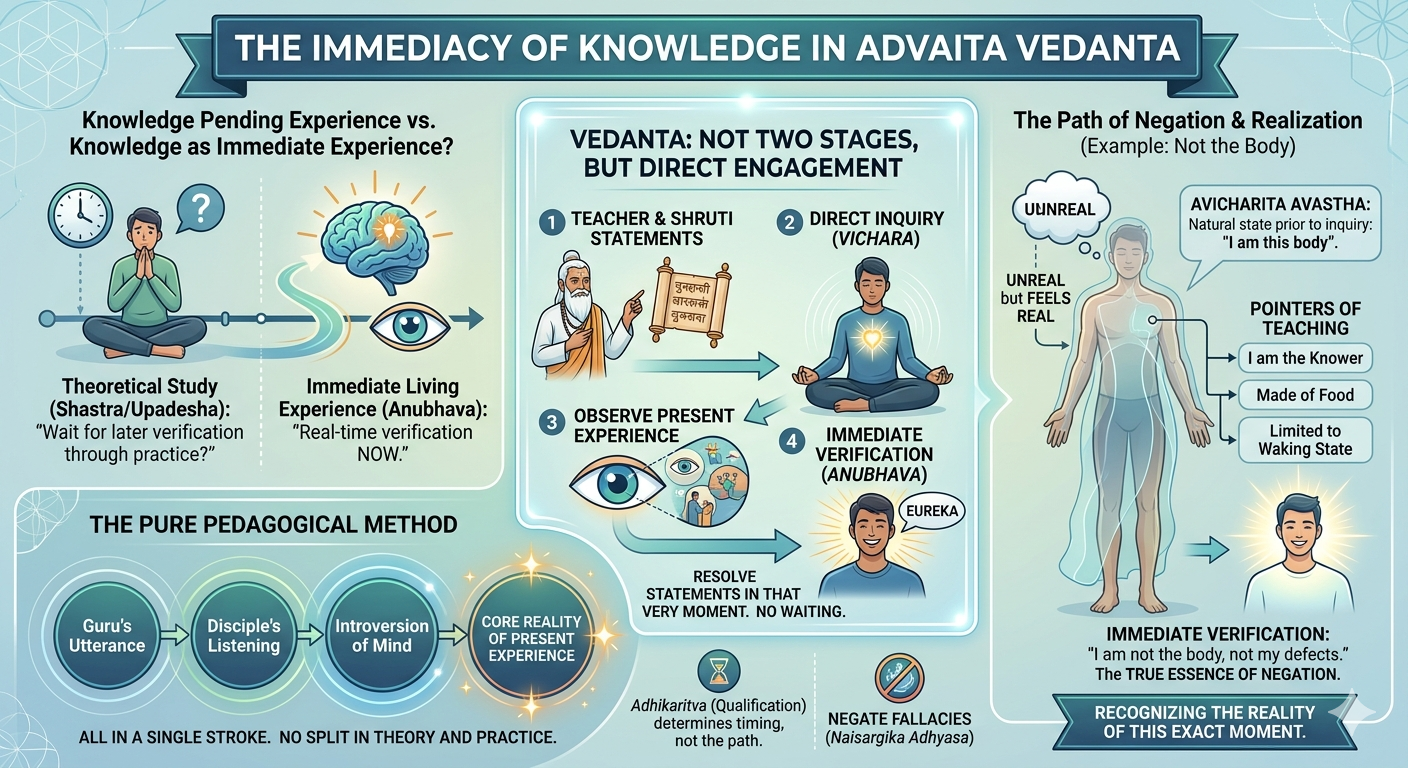
What is the difference between knowledge pending experience versus knowledge that is immediate experience in Advaita Vedanta? This question demands our attention, as many seekers may feel that the study of the shastra or upadesha is merely a theoretical enterprise that must be verified later through separate practice. My understanding of this topic is as follows.
Vedanta does not operate in two stages. It directly asks us to engage with and observe our real-time experience. Therefore, the statements made by the shruti or the teacher must culminate in one’s own living experience in that very moment, resolving the statement immediately. Consequently, there is no need to wait for a later time to verify it in any other way. We simply hear the statement, observe our own experience in relation to it, and verify the factual truth within our real-time experience itself.
If a proposed statement does not tally with our experience, certain ascertainment will not arise. In such cases, we must further hear, read, and contemplate the teaching, once again applying it to the living experience of the present moment. We may reflect upon it later, but that inquiry does not fundamentally differ from the initial observation. Even meditation simply means looking directly at the factual reality in alignment with the proposed statement, within our immediate experience. Vedanta never speaks without taking our living, present experience into consideration. We can observe this in the following example regarding why I cannot be the physical body.
Merely stating the theory that Brahman is bodiless will certainly not produce a state of bodilessness. But Vedanta does not present this as a mere theory; it attempts to reveal it within our own experience. You may ask which experience this refers to. Without delving into the complex nature of avidya, we must consider the very nature of the experience we are having right now. If we do not observe or contemplate in light of Vedantic teaching, we inadvertently think and feel that we are this particular body. Suresvaracharya calls this the avicharita avastha, the natural state of everyone prior to inquiry. This notion of oneself as the body, while unreal, appears completely real and feels like the only experience of the present moment.
However, because this illusion persists only due to a lack of investigation, the actual, factual experience can be traced in this very moment by following the pointers of Vedantic teaching. What Vedanta prompts is precisely this immediate looking. This seeming injunction to observe will reveal that, because one is the knower of the body, because the body is made of the food we consume, and because the body does not transcend the waking state, one’s intrinsic nature cannot be this body. Through looking, observing, and reaching an indubitable ascertainment, the realization that I am not the body, that this body does not belong to me, and that its merits and defects do not pertain to me, is instantly verified. This verification is the true essence of negation.
In pure Vedanta, as a direct guru-disciple pedagogical method, the guru’s utterance, the disciple’s listening, the introversion of the disciple’s mind, and the reaching of the core reality of the present moment’s experience can all happen in a single stroke. There is no scope for any split in the totality of the teaching into theory and practice. Whether a pupil can grasp the teaching in one go or requires repeated sessions of instruction depends entirely on their readiness. Regardless of the condition, the teaching, the inquiring mind of the pupil, the introversion, and the negation of the body ultimately resolve into the direct anubhava that there is an intrinsic separation between the knower and the known. This realization does not require any other kind of subsequent practice. Time and repetition do not alter reality; rather, they address the student’s adhikaritva, or inner qualification. Therefore, this path is not about attaining an experience other than the present one, but about recognizing the reality of this exact moment’s experience by negating the fallacies of naturally superimposed, or naisargika adhyasta, experience.
Hence, in my understanding, there is no need to imagine a kind of theoretical knowledge that lacks experience, waiting for a different kind of knowledge to bring about that experience. Here, we are dealing entirely with the immediate fact of the matter.